How Do I Get Motivated?

How Do I Get Motivated?

Anger often results from frustration and irritability as a result of procrastination and poor motivation. Being motivated and having greater appreciation and meaning for our lives certainly aid in managing our anger and emotions.  How do I get motivated or how to improve my motivation are great questions and ones that are frequently asked of me as a practicing licensed psychologist in Jacksonville, Florida. What is Motivation? Written for D’Arienzo Psychological Group by University of North Florida (UNF) Psychology Student and Future Industrial Organizational Psychologist, Brandon Araujo in December 2013, offers us great insight about the theory of motivation and how motivation is related to Maslow’s “Hierarchy of Needs.” I do think you will enjoy his article and find it helpful. Best Regards, Dr. D’Arienzo, Clinical and Forensic Psychologist, Jacksonville, Florida. 

What is Motivation?

Motivation is the psychological feature that arouses action from an organism. Behind everything we do there is some source of motivation, whether it be in the form of a desire, a need, or a fear. There are two main types of motivation, intrinsic and extrinsic. Intrinsic motivation is the stimuli coming from within an individual, meaning that they perform a task to fulfill a desire that is related to their belief system. Some forms of intrinsic motivation are, curiosity, power, belonging, and enjoyment. This type of motivation has been found to be the most effective and the most meaningful. Extrinsic motivation is the stimuli coming from an outside source that compels an individual to take action. Some examples of extrinsic motivation are food, money, praise, and promotions. While extrinsic motivation typically works for smaller less important tasks it seems to be ineffective with more important and meaningful goals.

Abraham Maslow, who was a 19th century psychologist, is famous for his theory of motivation (Maslow’s hierarchy of needs). This theory explains that extrinsic motivation is far less meaningful than intrinsic motivation. In this theory he proposed that motivation is broken up into five desires and rated them from basic needs to highly meaningful desires.

Maslow's Hierarchy of Needs and Motivation
Maslow’s Hierarchy of Needs and Motivation
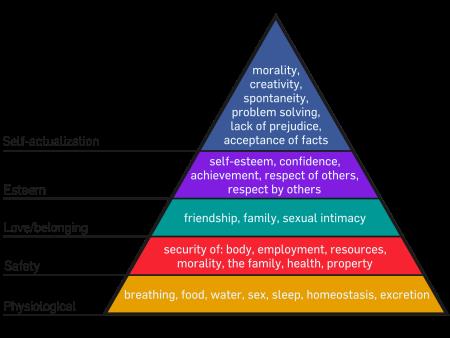
The first of these five and the most basic are physiological needs such as sex, food, water, and sleep. Next is the desire to feel safe from financial, personal and health related dangers. In the middle of Maslow’s hierarchy is the desire for love, belonging, and intimate relationships. Towards the top is the desire for self-esteem, confidence, and respect. The most meaningful and the most impactful motivational factor is the desire for self-actualization. This factor is highly intrinsic and describes our desire as humans to fully understand ourselves.

As a society we focus mainly on the bottom of this pyramid, which creates a sense of complacency to only want basic needs such as food, sex, and money, which decreases our motivation to complete more meaningful tasks. The best way to become more motivated is to change the rewards we link our goals with from these basic needs to the higher desires on the pyramid, such as, a sense of pride, a better understanding of our moral beliefs, and an increase in our talents. Being able to do this is highly dependent on our ability to think positively and see the possible importance of completing tasks, even the mundane ones. For example lets take the task of typing up multiple handwritten files. At first one may create the preconceived mindset that it is a pointless boring task they are only doing it make money. This results in low quality work due to their lack of motivation. On the other hand, a positive thinker may see it as an opportunity to develop his/her typing skills and will most likely enjoy typing up the files, which would cause the quality of work to increase. By incorporating this positive mindset of striving for highly meaningful goals and rewards, we can greatly increase our motivational levels, thus resulting in a more successful and satisfying life.

At D’Arienzo Psychological Group, we offer corporate in house anger management training, anger management therapy and counseling services at our practice, and certified online anger management training that can be found at the following links:


Four Hour Online Anger Management

Eight Hour Online Anger Management 

Managing Anger in the Workplace

Managing Anger in the Workplace

Managing Anger in the Workplace, Written for D’Arienzo Psychological Group by University of North Florida (UNF) Psychology Student and Future Industrial Organizational Psychologist, Brandon Araujo, December 2013. 

Anger is one emotion that everyone experiences in their life, but many people misinterpret the origin of their anger. The majority of individuals will label a situation or a person as the source of their anger; however, this is incorrect and is the base of many anger management issues. Situations or people do not make us angry; what drives this emotion is our own interpretation of those events and people. We make ourselves angry by becoming overwhelmed with our sense of cognitive dissonance.

Cognitive dissonance is the incongruence of our thoughts and expectations in relation to the events of our lives. In other words, when we expect something to happen but it does not we become frustrated. The retail business is a prime example; retail managers tend to set daily sales goals, and when these goals are not reached the managers become angry and frustrated. In turn, the managers direct these emotions towards their employees, even though the underachieved expectation is the actual source of their anger. Misdirection of anger can lead to multiple negative consequences in the workplace, such as, job dissatisfaction, counterproductive behaviors, and an increase in the company’s turnover rate.

Instead of directing anger towards their employees, the managers should analyze the expectations they had set and determine whether or not they were reasonable. If they were reasonable, they should examine why the goals were not met and what they can do in the future to assure that upcoming goals are reached. This type of reaction, in which we analyze and question the reality of our expectations, puts us in control of our anger. With this control we are able to direct our frustration to the actual source and use it as a tool to solve the problem.

Although this type of controlled reaction is ideal, we occasionally let our anger consume our thoughts and actions. This is especially true in a stressful work environment; the more stress that a job puts on an employee, the more likely they will have feelings of frustration and anger that they may direct towards other co-workers. This has a very negative impact on job satisfaction and productivity. Therefore, the ability to properly deal with an angry co-worker is a very important skill to have.

When an employee recognizes that a co-worker is angry and is directing that anger towards others, there are certain actions that the employee should and should not take in order to deal with the situation. The first and most important action they should take is empathizing with the co-worker, try to understand why they are mad in a genuine and compassionate manner; however, it is important not to force them to open up. After learning about why they are mad, the employee should try to help the co-worker gain control over their anger by assessing the reality of their failed expectations as previously stated in the sales goal example. After implementing this, one should provide minor assistance to help accomplish their co-workers newly assessed expectations, as long as doing so does not cause their own stress to increase. This strategy can also be used individually to help control one’s own anger. This type of empathic social-support within the workplace tends to increase job satisfaction and productivity among workers.

At D’Arienzo Psychological Group, we offer online anger management training and classes as well as in house group anger management training at your place of business. We also provide individual anger management counseling and therapy offered by either a licensed clinical social worker, licensed mental health counselor or a licensed clinical psychologist. Please contact us today for services that will be matched to your specific needs

Myths About Anger From SAMHSA

Myths about Anger from SAMHSA

Myths About Anger
Myth #1: Anger Is Inherited. One misconception or myth about anger is that the way people
express anger is inherited and cannot be changed. Evidence from research studies, however,
indicates that people are not born with set and specific ways of expressing anger. Rather,
these studies show that the expression of anger is learned behavior and that more appropriate
ways of expressing anger can also be learned.

Myth #2: Anger Automatically Leads to Aggression. A related myth involves the misconception
that the only effective way to express anger is through aggression. There are other more con
structive and assertive ways, however, to express anger. Effective anger management involves
controlling the escalation of anger by learning assertiveness skills, changing negative and hos
tile “self-talk,” challenging irrational beliefs, and employing a variety of behavioral strategies.
These skills, techniques, and strategies will be discussed in later sessions.

Myth #3: You Must Be Aggressive To Get What You Want. Many people confuse assertiveness
with aggression. The goal of aggression is to dominate, intimidate, harm, or injure another per
son—to win at any cost. Conversely, the goal of assertiveness is to express feelings of anger in  a way that is respectful of other people. Expressing yourself in an assertive manner does not blame or threaten other people and minimizes the chance of emotional harm.

Myth #4: Venting Anger Is Always Desirable. For many years, there was a popular belief that
the aggressive expression of anger, such as screaming or beating on pillows, was therapeutic
and healthy. Research studies have found, however, that people who vent their anger aggres
sively simply get better at being angry. In other words, venting anger in an aggressive manner
reinforces aggressive behavior.

Reilly PM, Shopshire MS, Durazzo TC, and Campbell TA. Anger Management for Substance
Abuse and Mental Health Clients: Participant Workbook. HHS Pub. No. (SMA) 12-4210.
Rockville, MD: Center for Substance Abuse Treatment, Substance Abuse and Mental Health
Services Administration, 2002.

ONLINE ANGER MANAGEMENT EIGHT HOUR COURSE $49.99

ONLINE ANGER MANAGEMENT EIGHT (8) HOUR COURSE $49.99

Our Online Anger Management Eight (8) Hour Course is a self paced anger management class that can be completed in the comfort of your home or on the go on your personal computer or other electronic device. It can be accomplished in as little as eight hours. The class is comprised of 9 video sessions that are approximately 15 minutes in length. Following each session you are asked to complete exercises that can be completed either in a notebook or using a word processing program. The program is designed in a format where you should spend a day to a week between each video session in order to complete each session exercise successfully. The course is completely self paced.

PayPal - The safer, easier way to pay online!

Online Anger Management Eight (8) Hour Class Link

In order to receive a certificate of completion you are to either complete a final exam that can be found at the end of the course or send us an electronic copy of your exercise responses.

Once the course is purchased, a code will be forwarded to you within 24 business hours granting you access to the course for 90 days.

We guarantee that you will find our anger management classes to be informative and helpful. Get started today for only $49.99!

If you are in need of a face to face session to supplement the online course please call the office to discuss pricing. A face to face session can be completed using electronic means or at our office in Jacksonville, Florida.

If you have questions about our anger management class please contact our office at 904-379-8094 or by email at admin@livebetterjax.com

   PayPal - The safer, easier way to pay online!

Online Anger Management Eight (8) Hour Class Link

We also offer help for disruptive physicians, disruptive employees, disruptive lawyers, and for other disruptive professionals. We provide emergent on-site interventions and consultations for your most difficult employees. Flexible treatment plans are available at our Jacksonville, Florida office based on your specific needs. We are available to assist you and your employees. Call us today!

Online Anger Management Eight (8) Hour Class Link

ONLINE ANGER MANAGEMENT FOUR HOUR COURSE $29.99

ONLINE ANGER MANAGEMENT FOUR (4) HOUR COURSE $29.99

Our Online Anger Management Four (4) Hour Course is a self paced anger management class that can be completed in the comfort of your home or on the go on your personal computer or other electronic device. It can be accomplished in as little as four hours. The class is comprised of 9 video sessions that are approximately 15 minutes in length. Following each session you are asked to complete exercises that can be completed either in a notebook or using a word processing program. The program is designed in a format where you should spend a day to a week between each video session in order to complete each session exercise successfully. The course is completely self paced.

PayPal - The safer, easier way to pay online!

Online Anger Management Four (4) Hour Class Link

In order to receive a certificate of completion you are to either complete a final exam that can be found at the end of the course or send us an electronic copy of your exercise responses.

Once the course is purchased, a code will be forwarded to you within 24 business hours granting you access to the course for 90 days.

We guarantee that you will find our anger management classes to be informative and helpful. Get started today for only $29.99!

If you are in need of a face to face session to supplement the online course please call the office to discuss pricing. A face to face session can be completed using electronic means or at our office in Jacksonville, Florida.

If you have questions about our anger management class please contact our office at 904-379-8094 or by email at admin@livebetterjax.com

   PayPal - The safer, easier way to pay online!

Online Anger Management Four (4) Hour Class Link

We also offer help for disruptive physicians, disruptive employees, disruptive lawyers, and for other disruptive professionals. We provide emergent on-site interventions and consultations for your most difficult employees. Flexible treatment plans are available at our Jacksonville, Florida office based on your specific needs. We are available to assist you and your employees. Call us today!

Online Anger Management Four (4) Hour Class Link